News

WRC Director Information Sessions

WSU water faculty and staff,

After 12 years as Director of the State of Washington Water Research Center (WRC), Dr. Jonathan Yoder stepping down June 30 of this year, and we are in the process of identifying a new director. WSU has a very deep and broad network of excellent water-focused researchers and educators who could lead the WRC very effectively into the future, so we are pursuing a WSU-internal search.

As part of this process, Dr. Yoder will be holding three Zoom meetings to provide a description of the WRC, what it has done over the last dozen years,  summarize basic director responsibilities, and discuss any topic anyone wants to discuss.

Meeting times are listed below with a zoom link are below.

Wed March 11 2-3 pm               (Zoom link)
Thurs March 26 11:30-12:30    (Zoom link)
Monday March 30 3-4 pm         (Zoom link)

In the near future we will be eliciting statements of interest for the Director Position. The process is still in development, but a general timeline includes a call for statements of interest publicized in late March, a deadline for that call in April, and a selection process in May/June.  This is subject to change.

The information sessions will target people who might consider becoming the Director of the WRC, but feel free to attend even if you just want to learn more about the WRC, what it does, and it’s future prospects.  And feel free to attend more than one!

Please contact Director Yoder at yoder@wsu.edu if you have any questions.
Call for WRC Research Seed Grant Proposals for FY 2026

The State of Washington Water Research Center (WRC) is soliciting research proposals for submission under Section 104(b) of the Water Resources Research Act. The objectives of this program are to sponsor research that fosters (a) exploration of new ideas to address water problems or expand understanding of water-related phenomena, (b) entry, education, and training of future scientists in water resource fields, (c) multidisciplinary research, and (d) dissemination of research results to academic and non-academic audiences.

Any proposal to advance scientific understanding of water resources and/or their management in the State of Washington will be considered, but priority will be given to integrative proposals that initiate new multidisciplinary collaboration or that will have a high likelihood of leading to multidisciplinary research efforts. Preference will be also given to early-career investigators, and proposals that support graduate student thesis and dissertation research. The review panel will be interdisciplinary and it would be beneficial to reflect this in your writing. Evidence of stakeholder support should be provided in the form of letters. Proposals addressing the following priority topics will be given preference:

  1. Climate change effects on water supply, demand, and quality.
  2. Analysis of policy and law relating to water resource management.
  3. Fate and transport of nutrients and emerging contaminants in the environment.
  4. Remote sensing of hydrologic systems and/or water use.
  5. Equity and justice in water resource access and management
  6. Surface-groundwater interactions and conjunctive use management.

We anticipate funding three proposals at up to $30,000 each ($10,000 minimum). Research expectations will be commensurate with funding request. The cost-share requirement is 1:1 ($10,000 and $30,000 depending on funding request) from non­federal sources, which can be satisfied with overhead, faculty time/salary, and cash match. Funding is contingent upon congressional allocation and release of FY2025 program funds. Grant duration will be tentatively September 1, 2026 – August 31, 2027.

Proposal submission deadline: Friday April 10, 2026, 5:00 p.m. (PST)

Eligibility: 

  1. Eligible: Faculty members or affiliates at institutions of higher education in the State of Washington.
  2. Ineligible: Applications for research on health effects involving human subjects.
  3. Ineligible: Applications for research involving oceanography (estuarine research applications are acceptable).

Updated proposal guidelines and worksheets:

We encourage you to work closely with us from the beginning if you intend to submit a proposal. Please contact Jacqueline McCabe at jacquem@wsu.edu, 509-335-5531 or Jonathan Yoder at yoder@wsu.edu, 509-335-8596 with questions.


Webinar: Skagit Watershed Studies – An Estuary, a Tributary, and the Groundwater

Please join us for this virtual event with three presentations focused on the Skagit watershed.
Tuesday, December 9, 2025, 10:00 am – 12:30 pm
Register at: https://bit.ly/44w7l1h


Washington State Representative Debra Lekanoff and Senator Keith Wagoner, former co-chairs of the Joint Legislative Task Force (Task Force) on Water Supply, are convening a presentation and discussion focused on three Skagit Basin water supply studies identified by the Task Force. Research teams will share their findings:
Skagit River Basin Groundwater Study

Study Lead: Chad Wiseman, Washington Fisheries Program Lead at HDR

Hydrologic Study of the Skagit Estuary

Study Lead: Correigh Greene, Skagit River System Cooperative and Northwest Fisheries Science Center, NOAA Fisheries (retired)

Skagit River Tributary Instream Flow Habitat Assessment

Study Lead: Thomas Gast, Principal Scientist at Thomas Gast & Associates Environmental Consultants

This research was facilitated by the State of Washington Water Research Center in conjunction with the Washington State Academy of Sciences. It was funded through a contract with the Washington State Department of Ecology.

The event is free but registration is required. Register at: https://bit.ly/44w7l1h

WRC Seminar: Water Rights and Water Banking in Washington State

Friday, October 24th, PACCAR 202, 2:00-3:00 p.m. or via Zoom (Meeting ID: 931 4831 0865  Passcode: 265031)

Aerial view of the Columbia River and Lake Entiat from Doc Searls from Santa Barbara, USA, CC BY 2.0 <https://creativecommons.org/licenses/by/2.0>, via Wikimedia Commons

Join Dan Haller for an interactive seminar on water rights in Washington State. What are water rights, how are they banked, and how much are they worth? How are they bought and sold, does an adjudication increase the value of water rights, and what is the risk of losing water rights? The answers to all these questions and more await!

Dan Haller, PE, CWRE, is a Senior Principal Engineer at Geosyntec Consultants focusing on water rights. His background includes management of storage and conservation projects; water banking and water rights transfers; and water system design, planning, and financial planning.

Water Research Center’s 2025 Spring Seminar Series

Did you miss our spring seminar series? The recordings of the presentations are available on the WRC’s YouTube Channel. Check them out to learn more about the work of our 2023-24 Seed Grant Recipients.

  • Evaluation of drawdown dynamics and implications for groundwater detectability with remote sensing
  • Evaluation of Remote Sensing Based Monitoring of Lake Water Quality in WA State
  • Exploring drainage water management as a tool for improving water quality in Washington

USGS National Water Availability Assessment Webinar

USGS National Water Availability Assessment Webinar

Date: Wednesday, May 21, 2025

Time: 3:00 PM – 4:00 PM EST 

Location: Microsoft Teams Webinar

Join the USGS Water Resources Mission Area for a briefing on the National Water Availability Assessment, a pioneering scientific overview of water availability across the conterminous United States. This new assessment is the first of its kind, offering new insights on where there is a potential imbalance between water supply and demand in the United States. The assessment uses state-of-the-art models to fill in gaps between monitoring sites and sampling events and integrates information on water quantity, quality and use for a more comprehensive understanding of water availability. The findings of the National Water Availability Assessment can be explored by reading the report, retrieving data from the user-friendly National Water Availability Assessment Data Companion, and touring the supplemental data visualization website. During this virtual event, attendees will learn about the key findings of the Assessment and how to access the data, hear stories of USGS water availability science across the country, and have the opportunity to ask questions of the team behind this effort. Register by clicking the button below or by copying and pasting the direct link into your web browser.
Register
Direct link for registration: https://events.gcc.teams.microsoft.com/event/596e6c86-cc0f-4c9c-bd24-1b9a582bcb02@0693b5ba-4b18-4d7b-9341-f32f400a5494

WRC hosts a Judicial Education Program for Washington State judges

The WRC hosted a two-day program on Water Sciences for Washington State Judges at the end of March. Faculty from WSU CAHNRS School of Economic Sciences, Biological Systems Engineering, CAHNRS-CAS School of the Environment, VCEA Civil and Environmental Engineering, and faculty from the University of Washington School of Aquatic and Fisheries Sciences led discussions on surface and groundwater hydrology, water use, anadromous fisheries science, hydroecology and water quality, irrigation science, agricultural economics, municipal water use and measurement, and the implications of climate and demographic change on water security and scarcity.

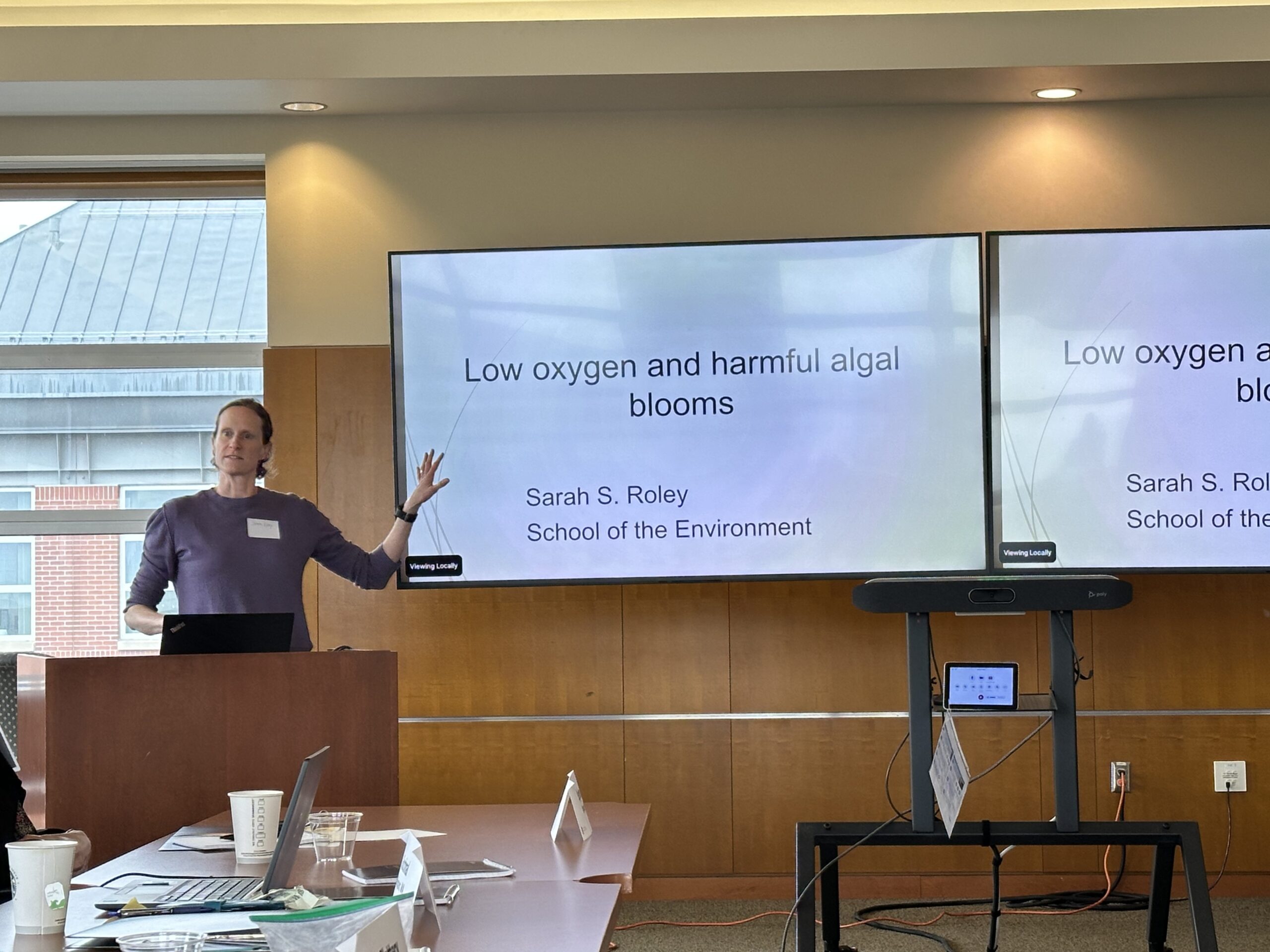
Dr. Sarah Roley discusses the science of Harmful Algal Blooms.
Dr. Sarah Roley discusses the science of Harmful Algal Blooms. Credit: Washington State Administrative Office of the Courts.

The WRC co-developed the program in collaboration with the National Judicial College (NJC) through their Dividing the Waters Program. “What impressed me and the Judges last week was how all of the diverse water science topics were all connected. Each topical discussion contributed to our broader understanding of how water sciences interact with each other and with the communities that rely on water”, said Alf Brandt, co-organizer of the program and Associate Director of Justice Solutions and Innovation at NJC and Dividing the Waters Staff. “The faculty had thought carefully about how judges use and need science in their water cases,” he said.

The second day of the program was a field trip that included visits to Lower Granite Dam on the Snake River, wetlands, irrigation projects, water treatment facilities, and conversations with a water bank manager. All judges attended, three faculty, and three WSU graduate students.

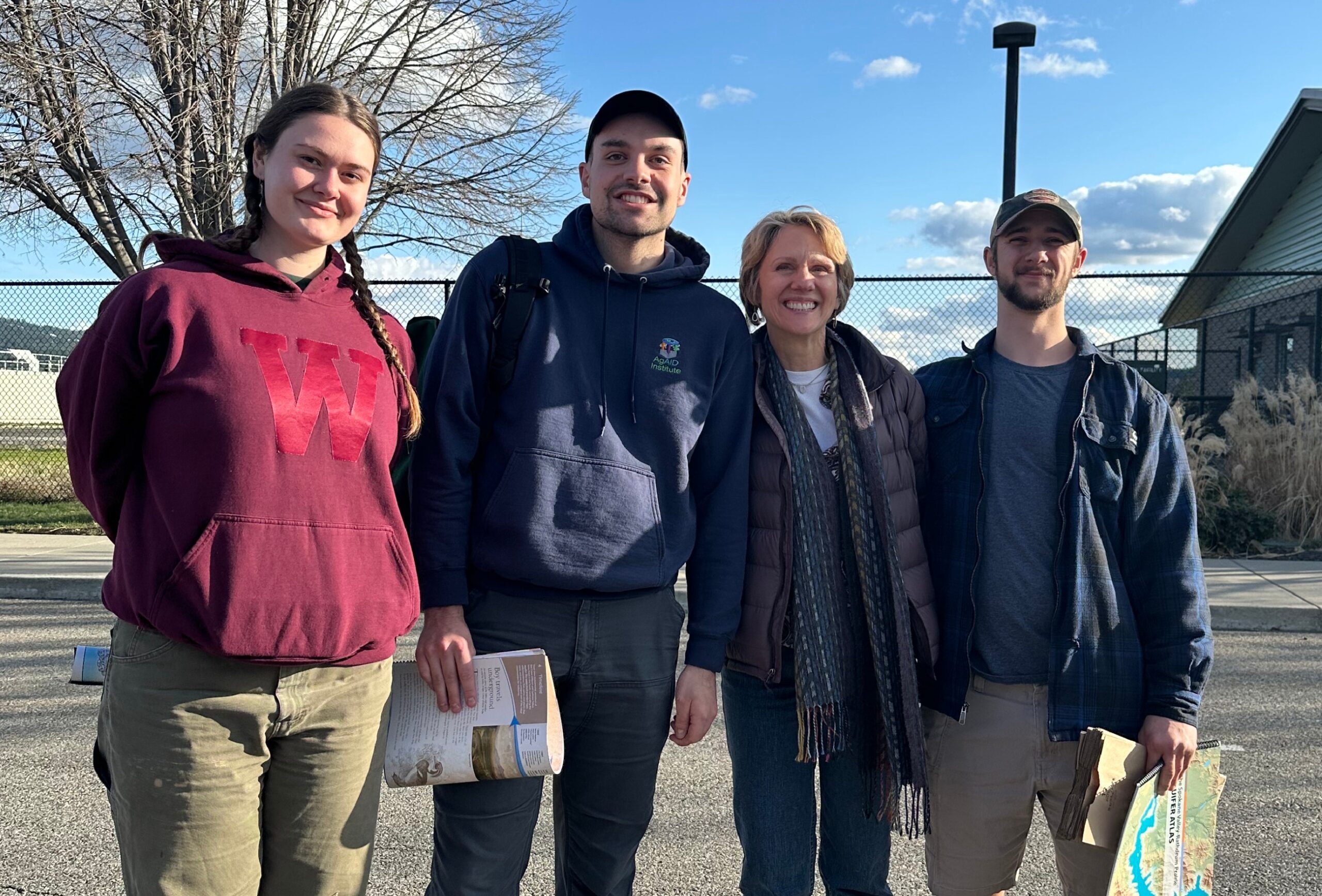
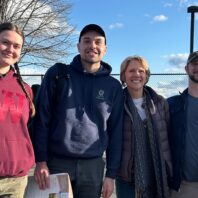
Graduate students (left to right) Sarah Hewitt (VCEA CEE), Jacob Gifford (CAHNRS SES), and Elijah Moser (VCEA CEE) with Washington State Chief Justice Debra Stephens at the Spokane County Water Resource Center. Credit: Washington State Administrative Office of the Courts.

Faculty and student contributors


Water Rights Market Seminar

The State of Washington Water Research Center is hosting a seminar focused on water rights markets. Please join us and presenter Philip Womble to learn more about this important work.

A Strategic Environmental Water Rights Market for Colorado River Reallocation

April 7 @ 2:00 pm – 3:30 pm

PACCAR 202, WSU Pullman

Philip Womble, Steven M. Gorelick, Barton H. Thompson, Jr., and J. Sebastian Hernandez-Suarez

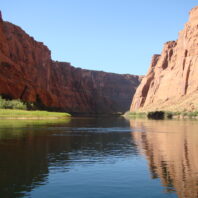
The Colorado River system is among the world’s most overallocated basins, struggling to supply water to the southwestern United States and Mexico. Consequently, 90% of the basin’s native fish species are endangered, threatened, or extinct. Driven by a regional 24-year megadrought, the U.S. allocated over $4 billion for water market transactions that pay farms, cities, and industries to extract less water. We developed a novel model of how strategic water markets can restore imperiled fish habitat, integrating hydrology, ecology, economics, and water rights for the river within Colorado under future climate change. Using the model, we explore how strategically spending modest additional funds improves fish habitat compared to least-cost water-use reduction plans under various plausible current and future formal and informal water markets. We demonstrate pathways to build towards strategic water markets by prioritizing individual transactions, and we compare ecological and economic outcomes of water markets to mandatory water cutbacks under the governing 1922 Colorado River Compact. By developing a decision support tool that conveys model results to water market participants, we can inform major ongoing initiatives to conserve water in the Colorado River basin.

Image by: Graphicsguy2, CC BY-SA 4.0 https://creativecommons.org/licenses/by-sa/4.0, via Wikimedia Commons

WRC 2025 Spring Seminar Series


Bring your lunch and learn about water resource issues and research in Washington State. The Water Research Center is hosting a virtual lunchtime seminar series this spring. We’ll hear from the Center’s 2023-24 seed grant recipients and learn how their research is informing some of Washington State’s water-related challenges.

Past Webinars:

Overabundant Water Stargrass Growth in the Yakima River: Consequences and Management Strategies

Thursday, March 20, 2025

12:00-1:00

Aaron Pelly, Ph.D. Candidate and Dr. Sarah Roley


Aaron Pelly and his Advisor, Dr. Sarah Roley, have been investigating the growth of water stargrass in Washington’s rivers. They will discuss how this aquatic plant impacts ecosystems and fish habitat, as well as strategies for managing it.

The webinar is free but registration is required. 

Learn more here.

The recording of this webinar is posted on the WRC Youtube Channel.


Evaluation of Drawdown Dynamics and Implications for Groundwater Detectability with Remote Sensing

Tuesday, April 15, 2025

12:00-1:00

Dr. Sasha Richey McLarty


Dr. Sasha Richey McLarty is conducting research on seasonal groundwater dynamics in the Mid-Columbia Basin. The study helps quantify drawdown and rebound in the aquifer and may have implications for how remote sensing is used to evaluate regional groundwater trends. Results may be useful for decision makers focused on water use in the basin.

The webinar is free but registration is required. 

Learn more here.

The recording of this webinar is posted on the WRC Youtube Channel.


Evaluation of Remote Sensing Based Monitoring of Lake Water Quality in Washington State

Monday, April 28, 2025

12:00-1:00

Dr. Emese Hadnagy, Dr. Gopal Mulukutla, and Dr. James Gawel


Dr. Emese Hadnagy and Co-PIs Dr. Gopal Mulukutla and Dr. James Gawel evaluated the use of satellite imagery to capture water quality conditions related to harmful algal blooms in lakes of WA state. The focus of this work was to develop water quality indicators to capture intensity and extent of bloom events to protect public health and inform lake management.

Learn more here.

The recording of this webinar is posted on the WRC Youtube Channel.


AWRA Call for Student Fellowship Applications

The Washington State Section of the American Water Resources Association (AWRA) is seeking nominations for its Fellowship Award. Three fellowships will be awarded for the 2024-25 academic year. One award will be to a member of a Washington Section affiliated AWRA Student Chapter. The other two awards will go to students enrolled in a graduate program at a college or university in Washington State. All fellowships are for a full-time graduate student completing an advanced degree in an interdisciplinary water resources subject. The award includes $2,500, a one-year membership in both the State and National AWRA, a one-year subscription to the Journal of the American Water Resources Association, and admission to the Washington State Section Annual Conference. Students enrolled in water resources programs within any academic department may submit an application for the award.

Applications must be submitted by 11:59pm on February 21, 2025.

The application can be found here <https://wrc.wsu.edu/documents/2024/12/awra-student-fellowship-application.docx>.

For additional information, contact Jason McCormick by email at jason@mccormickwater.com or by phone at (509) 949-7297.