Overview
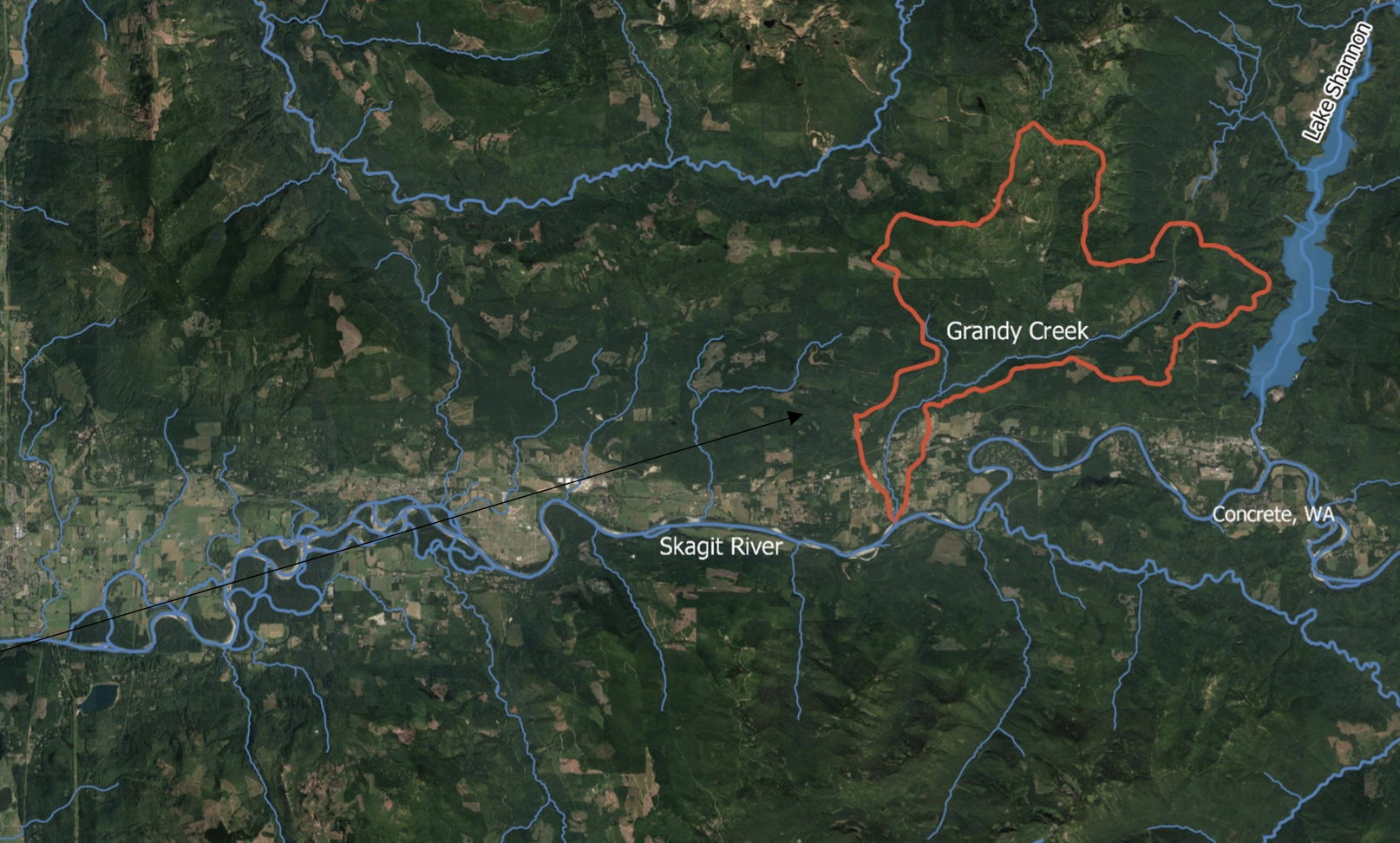
The Skagit River Tributary Instream Flow Habitat Assessment was a follow-up study to the 2019 Skagit Water Supply & Demand Analysis. The research models the relationship between streamflow and salmonid habitat in Grandy Creek. It compared available fish habitats under natural flow conditions and future scenarios.
Key Findings of the Skagit River Tributary Instream Flow Habitat Assessment
- The hydrologic changes in Grandy Creek from the climate and population growth scenarios only impact the life-stages present during the summer months. Climate change impacts to hydrology suggest a 15-20% reduction in summer streamflow, which would negatively impact salmonids using the stream at this time, including steelhead fry and juveniles, coho juveniles, and Chinook spawning.
- Spawning habitat is more prevalent in the lower reach of Grandy Creek, and is more responsive to flow changes than rearing habitat. Rearing habitat suitability is generally low across all flows due to limited instream cover and pool habitat.
- Restoration of rearing habitat (e.g., increasing pool frequency and instream cover) would be more effective than flow manipulation alone.
Report Summary, Submitted to the Washington State Joint Legislative Task Force on Water Supply 30 June 2025
 Presentation of Results, Skagit Watershed Studies: An Estuary, a Tributary, and the Groundwater
On December 9, 2025, the State of Washington Water Research Center hosted the Skagit Watershed Studies: An Estuary, a Tributary, and the Groundwater (recorded) with opening and closing remarks by Washington State Legislators, Former Co-chairs of the Joint Legislative Task Force on Water Supply:
- Representative Debra Lekanoff, 40th Legislative District of Washington State
- Senator Keith Wagoner, 39th Legislative District of Washington State.
Presenting research teams:
- Chad Wiseman, Groundwater Study Lead, Presentation: Part II: Skagit Groundwater Study
- Thomas Gast, Tributary Study Lead, Presentation: Part III: Skagit River Tributary Instream Flow Habitat Assessment Study
- Correigh M. Greene, Ph.D. Estuary Study Lead, Presentation: Part IV: Preliminary Evaluation of the Effects of Water Withdrawals on Estuary Habitats Study
Other presenters included:
- Ria Berns, Washington State Department of Ecology
- Michael F. Goodchild, Ph.D. Washington State Academy of Sciences
- Jonathan Yoder, Ph.D. State of Washington Water Research Center
- Julie Padowski, Ph.D. Washington State University
- Cindy Fabbri, Ph.D. State of Washington Water Research Center
Related Research