Abstract: Anthropogenic nitrogen (N) inputs have profoundly disrupted the terrestrial and aquatic N cycle, particularly in agricultural regions like the Palouse in Washington State. Fertilizer application promotes nitrate export into rivers, subsequently degrading water quality, fueling harmful algal blooms, and threatening ecosystem stability. Small headwater streams serve as critical filters for nitrate, yet predicting N removal in these systems remains challenging as traditional transport models do not accurately represent solu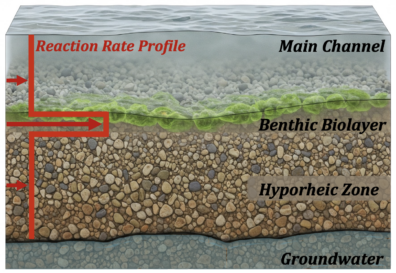 te residence times in the sediment bed. This study will advance our understanding of nitrate processing in low-order streams of the Palouse River by integrating hydrologic transport with N cycling dynamics. We employ “Timers,” a novel modeling framework that independently quantifies solute residence time in a river’s main channel, hyporheic zone, and benthic biolayer, the latter being a key site for microbial transformations. By integrating this framework with both simplified and complex N reaction networks, the latter considering ammonification, nitrification, denitrification, and dissimilatory nitrate reduction, we will test the standing hypothesis that biolayer residence time is the primary driver of riverine nitrate removal. By combining our mathematical modeling approach with experimental data, detailed sensitivity analyses, and established hydrological and biogeochemical uptake metrics, we aim to develop a predictive tool for evaluating nitrate removal efficiency in agricultural watersheds. This tool will specifically support management strategies to mitigate nitrate pollution and enhance water quality within the Palouse River network in Eastern Washington. These findings will lay the foundation for upscaling nitrate dynamics to entire river networks, a key objective of a future grant.